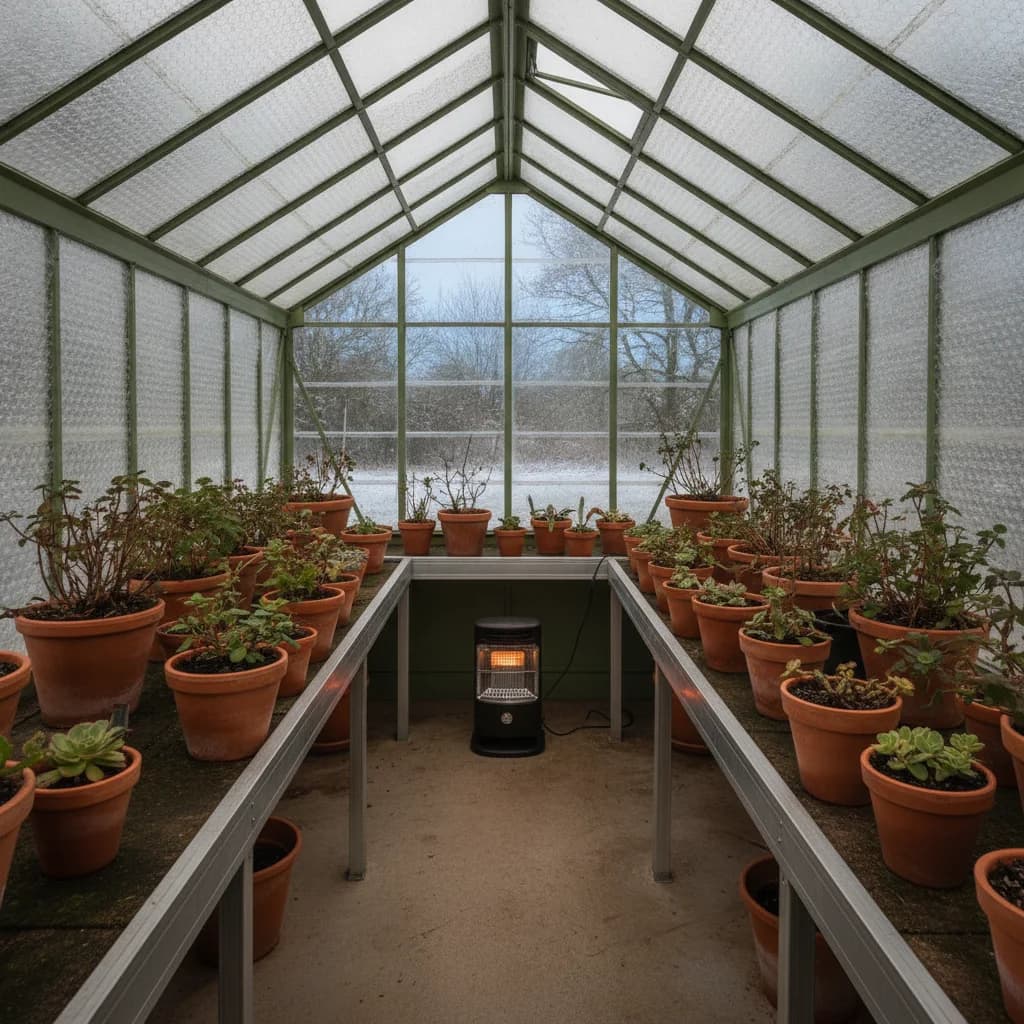
Price a greenhouse through all four seasons: transparent heater and fan energy math, current ventilation, shade and irrigation costs, plus panel reserve.
Budget
Quick answer: At the US Energy Information Administration's August 2026 residential forecast of 18.3 cents per kWh, a 1.5 kW heater costs about 27 cents for each full-load hour and a 2.8 kW heater about 51 cents. One hundred full-load hours cost $27.45 or $51.24. Heating usually dominates the recurring bill, but a complete ownership budget also names ventilation, shade, irrigation, water, cleaning, repairs, and replacement glazing. Dated hardware anchors checked August 31, 2026 include $59.99 to $97.50 for a passive vent opener, $169 for a 54 W exhaust fan, $55.99 to $130.99 for shade cloth, and $131.85 to $183.35 for a small drip kit. The $59.99 AutoVent and both Planta Phoenix listings were sold out, so those are price signals, not orderable recommendations. There is no defensible universal annual total because climate, target temperature, duty cycle, water rate, and the exact greenhouse change it.
Best for
Buyers who want the first-year equipment cost and the recurring four-season ownership cost before they choose a greenhouse.
Wrong fit
Buyers looking for one national annual number. The total needs a local electricity rate, heat-load calculation, runtime, water rate, and exact replacement parts.
Tradeoff
A lower kit price can hide years of heating and replacement cost. Better glazing costs more now, while a larger heated volume and proprietary panels can keep charging you later.
A 1.5 kW heater costs about 27 cents for every full-load hour at the US Energy Information Administration's August 2026 residential forecast of 18.3 cents per kWh. Run it for 100 full-load hours and the energy is $27.45. Run a 2.8 kW heater for the same 100 hours and it is $51.24. That is the arithmetic.
The part nobody can tell you from the kit photo is how many full-load hours your greenhouse will need. Climate, target temperature, glazing, gaps, perimeter loss, wind, sun, and thermostat cycling all move that number. A universal “$40 a month” promise is not a budget. This guide gives you the inputs, shows the arithmetic, and names the spring, summer, fall, and winter costs that belong beside heat.
Dated equipment prices below were checked August 31, 2026. They are reference products, not a recommended bundle. The Planta Phoenix and $59.99 AutoVent listings were sold out, so their prices are non-orderable signals. Your greenhouse may need a different size, more vent area, a different electrical circuit, or no powered equipment at all.
Ownership line
Current, checkable anchor
Transparent cost calculation
What still needs your number
Electric heat
Planta Phoenix 2.8 kW heater/cooler, $299 to $315 across two official listings, both sold out
$0.5124 per full-load hour at $0.183/kWh
Heat load, thermostat duty cycle, 240 V circuit and hookup
Powered exhaust
AC Infinity AIRLIFT S12, $169, 54 W, 830 CFM
1,000 full-power hours use 54 kWh, about $9.88 at $0.183/kWh
Required airflow, runtime, controls and installation
Passive vent opening
AutoVent $59.99, sold out; Bayliss opener $97.50
One-time hardware price
Live availability, number of vents, compatible brackets and replacement cylinders
Summer shade
30 to 70 percent cloth, $55.99 to $130.99, plus $12.99 clips
One-time material price before tax and shipping
Size, shade percentage, mounting and storage
Irrigation
Small drip-tape kit $131.85, or $183.35 with timer
One-time hardware price
Water consumption, local water rate, filter and winterization
Polycarbonate reserve
Ten-sheet material example: $620 to $1,850
About $41 to $185 per year when spread over Oklahoma State's 10 to 15-year expected life
Exact panel count, proprietary shapes, freight, waste and labor
Cleaning, seals and repairs
No single national number
Record actual compatible cleaner, seal, fastener and labor purchases
Model schedule, exposure, storm damage and who does the work
The panel reserve is deliberately visible math: current 4 by 8 foot, 8 mm twin-wall listings run about $62 to $185 per sheet. Ten sheets make a $620 to $1,850 material example. Dividing the low total by 15 years and the high total by 10 years gives roughly $41 to $185 per year. It does not mean your greenhouse takes ten standard sheets or that freight, cutting, hardware, disposal, and labor are included. Glass vs polycarbonate has the live sheet listings and the replacement-route stop gate.
Heating Cost: Runtime, Not a Made-Up Monthly Range
The EIA's August 2026 Short-Term Energy Outlook forecasts an average US residential electricity price of 18.3 cents per kWh for 2026. Use your own bill rate when you have it. The calculation is:
Full-load hours are not clock hours. A thermostat turns the heater on and off. One calendar month may contain few or many full-load hours depending on the weather and the heat loss. Use a heat-loss calculation to size the equipment, then use measured energy or a documented duty-cycle assumption to budget the bill. Do not multiply heater wattage by every hour in the month and call that a forecast unless you truly expect continuous full output.
How to Estimate the Heat Load
University of Georgia Extension separates greenhouse heat loss into three parts:
Use the source's imperial units exactly. In these equations, Q is Btu per hour, A is square feet, V is cubic feet, Ti - To is degrees Fahrenheit, and L is feet. R and P use the corresponding US customary heat-loss units. The 0.02 infiltration constant belongs to that unit system. Do not insert metric measurements without converting them or using a metric form of the calculation.
Conduction through the cover:Q = A × (Ti - To) ÷ R
Air infiltration:Q = 0.02 × V × C × (Ti - To)
Perimeter loss:Q = P × L × (Ti - To)
In that method, A is exposed surface area, Ti - To is the inside-to-outside temperature difference, R is the cover's resistance, V is greenhouse volume, C is air changes per hour, P is the perimeter heat-loss coefficient, and L is the distance around the perimeter. UGA gives 0.5 to 1 air changes per hour for a new greenhouse with double-layer plastic and 0.8 as the coefficient for an uninsulated perimeter. An older, leakier house needs a different input.
The result sizes heat capacity at the chosen design temperature. It does not produce a monthly bill by itself. Sun, wind, thermostat cycling, infiltration, and changing outdoor temperatures decide how long the equipment actually runs. Ask the greenhouse or heater seller to show the inputs if they quote one heating number.
Why Glazing Changes the Bill
A greenhouse loses heat through the glazing, frame, gaps, perimeter, and deliberate ventilation. Alabama Cooperative Extension publishes U-values of 1.13 for single glass and 0.65 for 8 mm twin-wall polycarbonate. Lower is better. Those values imply about 42 percent less conductive heat loss through the cited twin-wall panel for the same glazed area.
That is not a 42 percent lower total bill. Frame losses, air leakage, perimeter loss, wind, and ventilation remain. Ask for the exact product U-value on each quote instead of accepting “twin-wall” as the whole specification. A larger house compounds the problem because it adds exposed area and air volume. What size greenhouse do I need? shows where buying one size up stops being free space and starts being a permanent running cost.
The Complete Four-Season Ownership Worksheet
Put one number beside every row. Use $0 only when the feature is deliberately excluded, not because the product page stayed quiet.
Season
Cost to close
How to close it before buying
Spring
Water, drip hardware, filters, timer, seed heat if used
Price the exact kit, calculate gallons, and apply the local water rate
Summer
Roof vents, low inlets, powered exhaust if required, shade and fan energy
Check vent area and fan sizing, then price hardware and expected runtime
Fall
Compatible cleaner, seals, fasteners, gutter cleanup and winterization
Use the glazing maker's care rules and the exact irrigation drain-down plan
Winter
Heater, safe electrical hookup, insulation, energy and backup frost plan
Run the UGA heat-load method, use the local kWh rate, and state the target temperature
Every year
Replacement reserve, storm inspection and paid maintenance if used
Get one panel or pane SKU, delivered price, lead time and installation method in writing
For the first year, add the selected one-time equipment to the recurring energy, water, consumables, maintenance, and replacement reserve. For later years, remove equipment you do not need to buy again, then add actual repairs. Do not add every reference product in this article automatically. A passive opener and a powered exhaust package solve different designs, and the correct combination depends on the greenhouse.
What We Could Not Verify as One National Number
Annual heating cost without the exact structure, location, target temperature, leakage, and measured or modeled runtime
Annual water cost without gallons and the local water tariff
Cleaning, sealant, wood-finish, and paid-maintenance cost across different frame and glazing systems
Installed replacement cost for a proprietary curved panel or tempered pane
One ventilation package that fits every floor area, vent layout, and climate
Unknown is not free. It is a quote line.
When Heating Is Worth It
Frost protection at 35 to 40F is the sensible goal when you want to keep tender plants alive. Use the load calculation, twin-wall or better insulation where appropriate, a thermostat, and a heated bench for trays that need more warmth. Overwintering plants in a greenhouse maps plant minimums to the temperature decision.
Cool growing at 45 to 50F can support hardy crops and earlier starts, but it raises the design-temperature difference and the runtime. Calculate it as a separate scenario instead of adding a vague winter allowance.
Warm growing at 55 to 65F is the expensive goal in a cold climate. If the real use is a comfortable room for working or reading, a greenhouse is the wrong envelope. It is built for plants, not living-room efficiency.
Before you buy heat, test the cheaper boundary: seal unintended gaps, use compatible winter insulation, heat only the crop zone that needs it, and check how far row cover and thermal mass can extend the season. Keep intentional ventilation. A sunny winter afternoon can still overheat a sealed greenhouse, and damp stagnant air creates a different failure.
Frequently Asked Questions
How much does it cost to heat a greenhouse in winter?
Start with full-load hours, not a national monthly range. At 18.3 cents per kWh, a 1.5 kW heater costs $27.45 for 100 full-load hours, $82.35 for 300, and $137.25 for 500. A 2.8 kW heater costs $51.24, $153.72, and $256.20 for the same run hours. Your heat-load calculation and thermostat duty cycle determine which row belongs to your winter.
Is it cheaper to heat a glass or a polycarbonate greenhouse?
Multi-wall polycarbonate usually wins on conductive heat retention, but compare exact products. Alabama Extension lists U-values of 1.13 for single glass and 0.65 for 8 mm twin-wall polycarbonate. That is about 42 percent lower conductive loss through the cited panel, not a guaranteed 42 percent lower utility bill. Frame, gaps, perimeter, wind, and ventilation still count.
Do I really need to heat my greenhouse at all?
Only if the plant and season goal needs it. Spring seed-starting and season extension can work without full-house heat. Tender-plant overwintering may need frost protection. Warm winter crops need a higher target and more energy. Decide the temperature goal first, then size and price the system.
What is the cheapest way to keep a greenhouse from freezing?
Reduce the load before buying more heater. Use the correct glazing, seal unintended gaps, insulate compatibly, keep the heated zone small, and use a thermostat. Then calculate the remaining heat requirement with the greenhouse area, volume, perimeter, temperature difference, R-value, and air changes. A heated bench is often more direct than warming empty air around a few trays.
Is a heated greenhouse worth it, or should I just buy a bigger one to heat less?
Bigger is the wrong direction if heating cost is the worry. It adds exposed area and volume. Buy the size that fits how you garden, calculate the load, and heat only the zone and temperature the plants need. The sizing tradeoff is in what size greenhouse do I need.
Will heating my greenhouse make my electric bill jump?
It can. The bill moves in exact proportion to heater input, full-load runtime, and the local electricity rate. A 2.8 kW heater uses 280 kWh in 100 full-load hours. At the EIA reference rate, that is $51.24. Replace 18.3 cents with the rate on your bill and use a realistic runtime rather than a best-case guess.
These guides are built from manufacturer documentation, public specifications, primary research where health claims matter, and repeated buyer questions that show up in real ownership and installation decisions.
Manufacturer responses can clarify pricing bands, warranty terms, support footprint, or common mistakes. They do not move a page up the shortlist on their own.