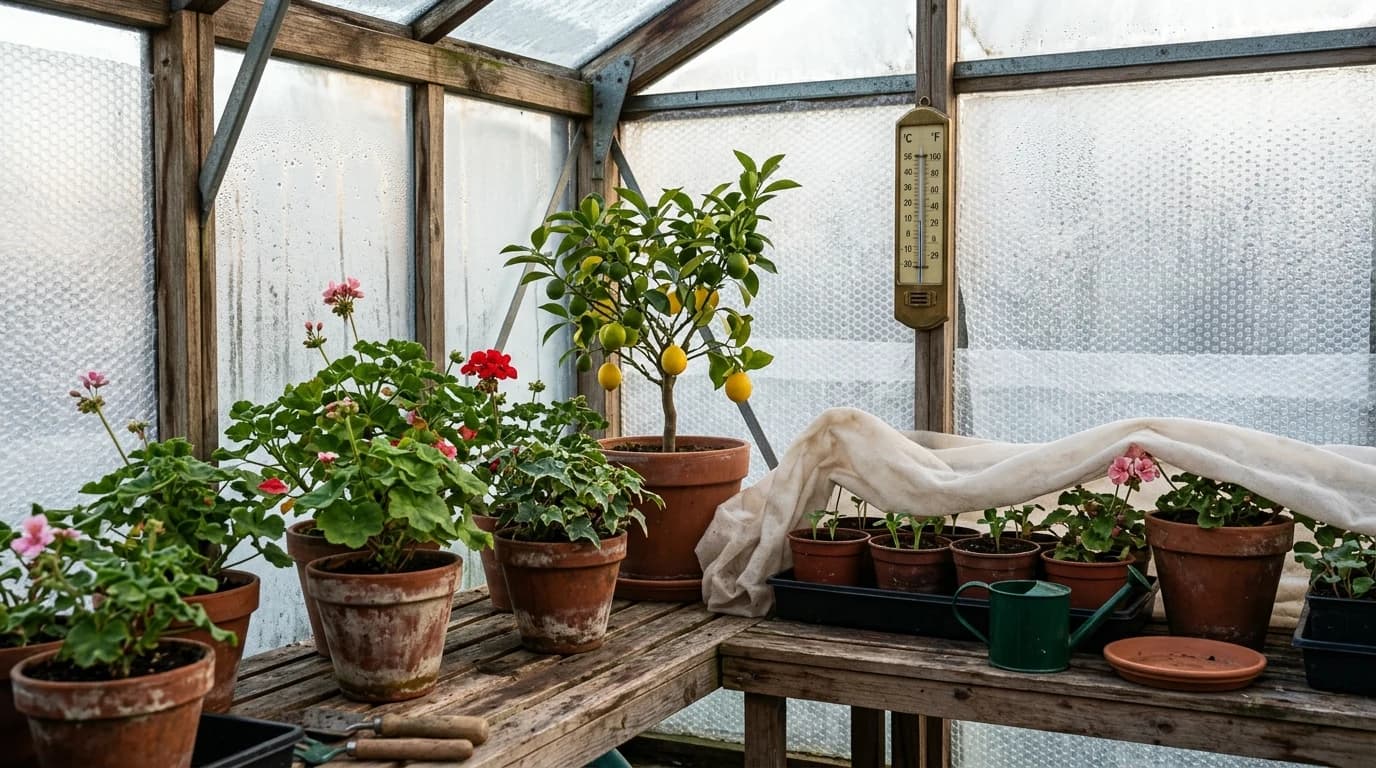
Overwintering in a Greenhouse: What Survives, Costs
What survives an unheated greenhouse, which plants need 40F or more, and what each temperature tier costs to hold. Sourced from RHS and extension data.
Installation
Quick answer: An unheated greenhouse overwinters hardy plants and cold-tolerant greens, but it is not a frost-free room: on clear, calm nights it can run 2.5 to 10F colder than outside, per University of Maryland's Ask Extension service. Tender favorites need real temperature floors, sourced from RHS growing guides: pelargoniums and half-hardy fuchsias need frost-free (about 40F), lemons hold at 41F, but limes and grapefruit need above 50F and calamondin oranges 55F. The cost ladder, from our heating data at roughly $0.16/kWh: frost-free in a small twin-wall house runs about $10 to $120 a month depending on climate, while a warm house at 55F runs $120 to $300, more for larger houses. Match the plant list to the tier before you buy the heater.
Best for
Greenhouse owners deciding what to bring in this fall and whether to heat, and buyers sizing a greenhouse around keeping tender plants alive.
Wrong fit
Growers extending a harvest of winter greens. That is a different job with different math, covered in the season extension guide.
Tradeoff
Every 10 degrees of winter minimum you promise your plants multiplies the heating bill. The cheap move is matching plants to the coldest tier they genuinely tolerate, not heating the whole house to the neediest plant.
The first thing to know about overwintering plants in a greenhouse is the one nobody puts in the brochure: an unheated greenhouse is not automatically warmer than the night outside. On clear, calm nights it can be colder. University of Maryland's Ask Extension service puts an unheated structure at 2.5 to 10F below the outside temperature on those nights, and greenhouse owners on Reddit log the same surprise every winter. Glazing traps cold air and radiates heat to the sky, and without thermal mass or heat, "protected" can mean "frozen, indoors."
So this page puts a temperature floor, and a monthly cost, on every overwintering promise. Every temperature here is sourced from RHS growing guides or university extension data, and every cost line comes from our greenhouse heating cost guide.
One boundary first: this page is about keeping plants alive through winter. If your goal is harvesting greens into December, that is season extension, a different job with different math, covered in season extension in a greenhouse.
Quick Answer: The Four Tiers, What Survives, What They Cost
Tier
Night minimum
What survives
Monthly cost, small house*
Unheated
Whatever the night brings, sometimes colder than outside
Hardy plants: chrysanthemums, cyclamen, violas, pansies, early bulbs, hardy greens. Penstemons and salvias usually cope (RHS)
$0
Frost-free
About 40F (RHS defines frost-free as a 4C night minimum)
Pelargoniums, half-hardy fuchsias, many Mediterranean pot plants, the toughest lemons
$10-40 mild climate, $40-120 cold climate
Cool
45-50F
Pelargoniums kept flowering, tender fuchsias (41-50F), lemons and kumquats comfortably
$20-70 mild, $70-200 cold (interpolated between tiers)
*Twin-wall polycarbonate, roughly $0.16/kWh, from the heating cost table. A single-glass house will usually cost more to heat, but do not apply a fixed multiplier without exact glazing U-values, frame construction, leakage, wind, and ventilation. All figures are illustrative; your rate and your winter move them.
The pattern that saves you money: the jump from unheated to frost-free is cheap and saves the most plants. The jump from frost-free to warm is expensive and saves a handful of species. Most owners should heat to frost-free, group the needy plants, and stop there.
Tier 1: What an Unheated Greenhouse Really Does
An unheated greenhouse buys wind protection, dry foliage, and a buffer against frost events, not a stable climate upgrade. The folklore that a greenhouse "adds one or two zones" has no extension source we could find. The closest published figure is Oklahoma State Extension's, and it is about in-ground growing in high tunnels: two to three hardiness zones, with a row cover adding roughly one more. For plants in pots, the math is worse, not better, for a reason covered in the next section.
What genuinely holds in an unheated house, per the RHS: hardy ornamentals like chrysanthemums, cyclamen, violas, pansies, and early bulbs, with penstemons and salvias usually coping. Hardy lettuce, pea shoots, broad beans, and peas overwinter for spring. Add a row cover inside and you gain protection down to roughly 24 to 28F under the fabric, per West Virginia University Extension.
The documented limits: UMass Extension warns that even covered, unheated poly houses risk plant injury after two or more consecutive nights below 0F outside, and Cornell logged minimally heated tunnels falling into the 20s F inside during extreme cold. And on clear, calm nights the Maryland finding applies: without thermal mass, the inside can be colder than the yard. If your winters deliver those nights, an unheated house is a gamble for anything you love.
Why Container Plants Die in Winters They Should Survive
This is the piece of science the usual overwintering lists skip, and it explains most winter losses. Roots are much less cold-hardy than shoots. UMass Extension puts it exactly that way, and notes Oklahoma research showing the root ball in an unprotected container can approach the ambient air temperature, because the only insulation is the pot wall.
In the root-kill data UMass publishes (from Havis's root-hardiness research and Perry's perennial production data), a flowering dogwood's roots die at 20F and boxwood roots at 15F, while both shrubs shrug off far colder air in the ground. Among perennials, Heuchera 'Chatterbox' roots are injured at 14F, while a hardy Sedum 'Autumn Joy' takes -11F. A hardy-zone label describes the plant in the ground, not in a pot on your greenhouse bench.
The practical moves: aim for pot soil temperatures of 30 to 34F for most perennials, since UMass warns that below 30F starts killing sensitive species. Water everything well before hard freeze-up, and let the foliage dry first: UMass notes that moist soil freezes far slower than dry, and freezing water actually releases heat. Once temperatures consistently hit 25-30F, a thermal blanket over the pots creates a microclimate 8 to 10F warmer than the air above it. Cluster pots together, pot-in-pot or against the most sheltered wall, and treat an exposed bench like the exposed place it is.
The Fall Calendar: When Things Go In, When They Come Out
Timing is half the job, and the extension sheets are specific about it:
Tender plants (pelargoniums, fuchsias, citrus, tropicals) go in before the first frost, not after the first close call. One hard night undoes the whole plan.
Check for pests before anything comes in. Inspect leaves and stems, wash foliage, treat what you find, and strip dead material. Aphids, scale, or spider mites carried into a closed house in October become an infestation by February, with no predators to slow them. The full prevention playbook is in the pest and disease guide.
Hardy container stock gets covered later than feels natural. UMass's guideline for covering overwintering structures is first frost date plus 30 to 45 days: an October 15 first frost means covering in mid-to-late November. Covering too early holds heat and humidity, and plants that have not gone fully dormant rot instead of resting.
Rodent control starts a month before covering. UMass recommends screening the perimeter with buried hardware cloth and beginning control before you tuck everything in, because mice move into quiet, covered structures in late fall.
The spring exit is a walk, not a sprint. UMass advises inspecting protected plants frequently for early shoot growth and venting with cool air to slow it, because a warm February week wakes plants before the light and the frost calendar support them. Move tender plants back out after your last frost, hardening them off over a week or two.
Tier 2: Frost-Free, the Tier Most Owners Should Buy
Frost-free is the workhorse tier. The RHS defines it as a nighttime minimum of 4C, about 39F, and UGA's hobby greenhouse guidance sets the frost-protection thermostat at 40F. Hold that line and you keep pelargoniums, overwinter half-hardy fuchsias, carry tender herbs like rosemary and sage per UNH Extension, and keep the toughest lemons, which the RHS says are fine as low as 41F. If lemons are the point, set the thermostat a notch up, at 41-42F, so the floor matches the plant.
What it costs, from our heating cost data: a small twin-wall house held at 40F runs roughly $10 to 40 a month in a mild climate and $40 to 120 in a cold one. Glazing is a major part of the load. Alabama Extension's U-values for single glass and 8mm twin-wall polycarbonate imply about 42 percent less conductive heat loss through the cited twin-wall panel, but that is not a 42 percent lower total bill because frames, gaps, wind, and ventilation still matter. Compare the exact U-value in glass vs polycarbonate before sizing the heater. To choose the heat source itself, how to heat a greenhouse ranks nine methods by cost, and the best greenhouse heater sizes a unit to your floor area.
Heater size has to be calculated, not guessed. University guidance (UGA, Purdue) sizes a heater as heat loss = surface area x temperature difference / glazing R-value. Worked example with UGA's published R-values: a 6x8 single-glass house, about 190 sq ft of exposed surface at R-0.9, holding 40F against a 15F night, needs roughly 5,200 BTU/hr, about a 1.5 kW heater running flat out. Make the night colder or the house bigger and the folk wisdom "2 kW does a small greenhouse" quietly stops being true: the same house against a 0F night needs about 2.5 kW. Run your own numbers before you buy, and buy thermostatic, because the thermostat is what keeps the monthly bill in the $10-40 band instead of the heater's nameplate suggesting ten times that.
Tiers 3 and 4: Cool, Warm, and the Citrus Split
Citrus is where "frost-free is enough" quietly kills plants, because the family splits by species. Per the RHS citrus growing guide: some lemons are fine as low as 5C (41F), kumquats often need 7C (45F) or more, limes and grapefruit should be kept above 10C (50F), and calamondin oranges need at least 13C (55F). A frost-free house carries the toughest lemons. A lime needs the warm tier, and the warm tier is the expensive one.
How expensive: holding 55F through a cold-climate winter runs $120 to 300 a month for a small house and more for larger ones, per the heating cost table, which is why that guide's blunt line applies: in a cold climate, warm growing can cost more per winter than the plants are worth. The cheaper play for one or two tender plants is a warm corner, not a warm house: heat the whole structure to frost-free and give the lime a bubble-wrapped corner with a small local heater, or winter it indoors under a grow light and let the greenhouse hold the 40F crowd.
Pelargoniums sit in the comfortable middle: they survive frost-free, and the RHS notes many keep flowering if held at 7-10C (45-50F). That is the cool tier, worth its modest premium if winter flowers matter to you.
The Protection Kit, With Published Numbers
The classic winter-prep kit is mostly right in direction and vague on size. Here is what the numbers support:
Bubble insulation on the glazing. The "cuts heat loss 30 to 40 percent" figure quoted everywhere has no primary source we could find. What the engineering data supports: adding a trapped-air layer roughly doubles the R-value of single glazing per UGA's published tables, cutting conduction loss by about a third to a half on the covered surface. The RHS does publish the trade-off: about 10 percent of your light, which is real money for winter growth. Worth it on a heated house, pointless on a fully unheated one with nothing tender inside.
Horticultural fleece. The RHS figure is about 2C (roughly 3-4F) of frost protection, for the heavier 35gsm grade, and it can be double-layered. Treat bigger vendor claims as marketing.
Thermal mass. Water barrels are the classic fix for the colder-than-outside problem, and the Maryland extension answer names them as the remedy. Keep the scale in view: the impressive figures, 18 to 36F over ambient, come from engineered passive-solar greenhouses with insulated north walls and tons of water, per UGA, and no extension source quantifies what two barrels do in a hobby house. Expect a real but modest smoothing of the overnight low, not a heater replacement.
Seal and ventilate, both. Caulk gaps and fit foam to cold panels per UNH Extension, but keep venting on mild days: UMass advises ventilation once an overwintering house pushes past 40F (45 to 50F for white poly houses), and its sheets warn to check covered plants frequently for botrytis, because trapped humidity breeds mold on dormant foliage. In the extension guidance, winter disease is treated as seriously as winter cold. The sourced humidity thresholds and the cheap fixes for a foggy, still winter house are in greenhouse condensation and humidity.
Dormancy Care Through the Dark Months
Overwintered plants are held, not grown, and the care schedule flips accordingly. Water sparingly: an unheated poly house may need water only every two weeks or even less often per UMass, and Maryland Extension's rule for tender plants is to lessen watering and hold fertilizer until new growth shows in late winter. Overwatering in winter is one of the most common killers, because soggy pots rot dormant roots. The one exception worth knowing: the RHS actually recommends a winter feed for citrus from November to mid-March, so the no-fertilizer rule is a default, not a law.
Check plants every week or two for botrytis, vent on mild days, and resist the spring itch: hold the line until the calendar section's exit rules apply.
If you are still choosing the greenhouse itself, winter performance is a buying criterion, not an accessory: glazing, sealing, and structure decide what these tiers cost you every year, and the models that hold heat are mapped in best greenhouses for cold climates.
Frequently Asked Questions
Can an unheated greenhouse provide enough heat to stay above freezing?
Usually not. An unheated greenhouse protects against frost events, wind, and wet, and hardy plants overwinter well in one, but it does not hold a floor above freezing through a real cold spell, and UMass warns of plant injury once outside temperatures spend two or more consecutive nights below 0F. If a plant genuinely cannot take freezing, it needs a heat source holding about 40F, which in a small twin-wall house costs from around $10 a month in a mild climate.
Inside Greenhouse is COLDER than outside temp
That is the exact title of a heavily-discussed Reddit thread, and the effect is real: radiative cooling. On clear, still nights the glazing radiates heat to the open sky while trapping the coldest air inside, and University of Maryland's Ask Extension service puts the effect at 2.5 to 10F below the outside temperature. For overwintering, the consequence is blunt: plants you moved in for protection can freeze harder than they would have outdoors. The fixes are thermal mass to release stored daytime heat, and for anything tender, an actual heater. A max-min thermometer is the cheapest overwintering tool you can buy, because it tells you what your greenhouse actually does at 4 a.m.
If I transplant them in a pot and keep them in this unheated greenhouse, would they survive?
That question, asked verbatim about geraniums and fuchsias on r/gardening, has a two-part answer. In mild-winter regions, often yes with fleece and luck. Reliably, no: the RHS overwinters pelargoniums (bedding geraniums) in a frost-free place, about 40F at night, and half-hardy fuchsias the same way, with truly tender fuchsia varieties needing 41-50F. In a pot the roots are more exposed than the hardiness label assumes, since roots are far less cold-hardy than shoots. If the plants matter to you, frost-free is the insurance, and it is the cheap tier of heating.
Curious if bubble wrap works as insulation?
Yes, but you lose about 10 percent of your light. A bubble layer adds a trapped-air gap that roughly doubles the R-value of single glazing per UGA's data, cutting conduction loss by about a third to a half on the surfaces it covers, and the light-loss figure comes from the RHS. It lowers the heating bill; it does not turn an unheated house frost-free through a real cold snap. Because of the light cost, insulate a heated house, and skip it if nothing inside needs the warmth.
Is it worth the investment (initial cost + electric heating) or would it be better to just use the grow lights I already have in the basement?
Count the plants. For one or two tender pots, an indoor spot under a grow light wins on cost, since holding a whole greenhouse frost-free runs $10 to 120 a month depending on climate and glazing. For a collection, the greenhouse wins on light, humidity, and space, and frost-free is all most collections need. The expensive mistake is heating the entire house to the neediest plant's requirement: hold 40F for the many, and give the one lime a heated corner or a winter indoors.
These guides are built from manufacturer documentation, public specifications, primary research where health claims matter, and repeated buyer questions that show up in real ownership and installation decisions.
Manufacturer responses can clarify pricing bands, warranty terms, support footprint, or common mistakes. They do not move a page up the shortlist on their own.