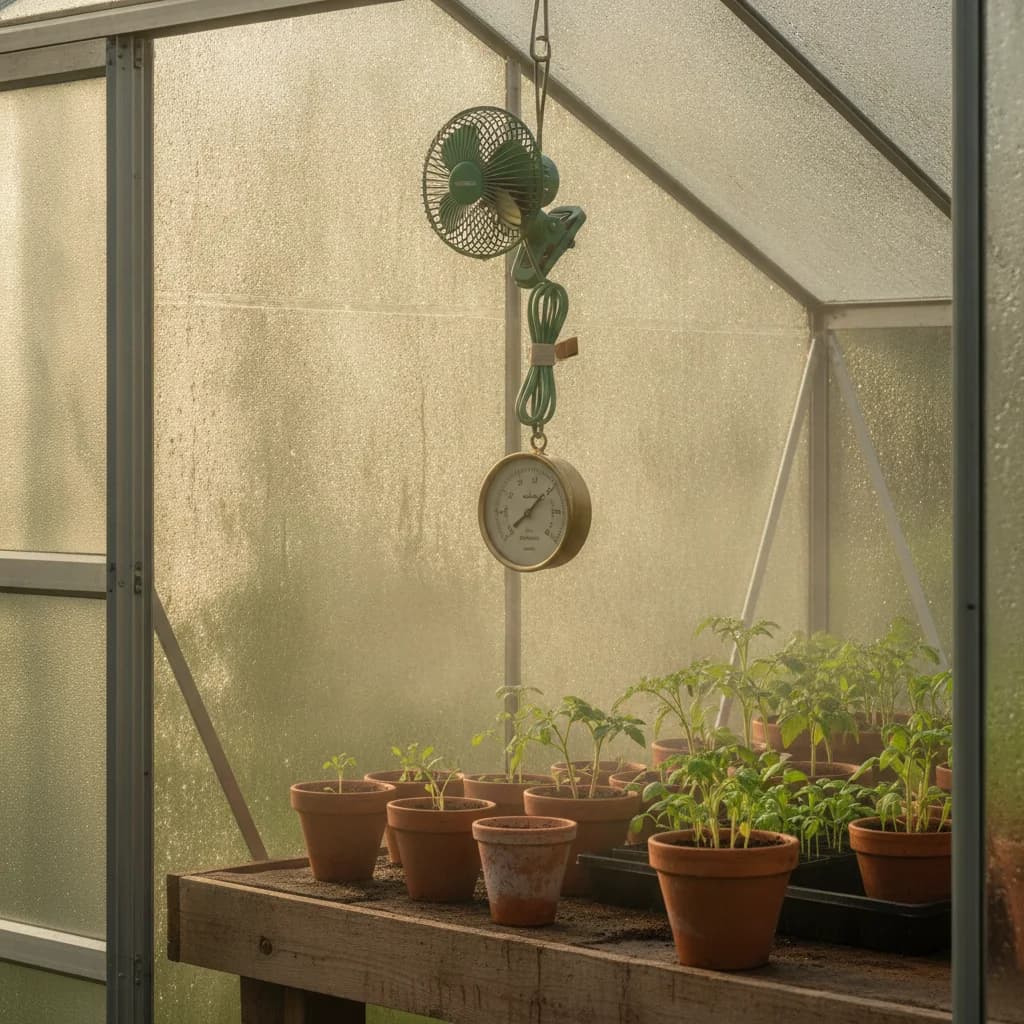
Why greenhouse glazing drips at night, what humidity causes mold, and whether a $22 fan or a $180 dehumidifier fixes it. Sources: UMass, RHS, Penn State.
Installation
Quick answer: Condensation on greenhouse glazing is normal on cool nights and mostly harmless by itself. It becomes a problem when the air around the plants, not just the glazing, stays above roughly 70 to 85 percent relative humidity for hours, which is when gray mold (botrytis) and other fungal disease take hold. University of Massachusetts Extension puts botrytis infection at 85 percent RH or higher held for 8 to 12 hours; the RHS names 70 percent in still air as the threshold worth acting on. Fix the boundary layer of still, damp air around the leaves first: a small circulation fan (about $22) solves most backyard cases. Venting for a few minutes at dusk while running a little heat, and watering in the morning instead of the evening, handle most of the rest. A dedicated dehumidifier (from about $180) is a real fix, not the first one, for a heated house with a chronic problem the fan and venting do not solve.
Best for
Greenhouse owners with fogged-up glazing, water dripping on plants, or the start of gray mold, and buyers weighing glazing and ventilation with humidity in mind.
Wrong fit
Growers looking for pesticide or fungicide dosing for an active outbreak. See extension resources or a local expert for treatment.
Tradeoff
A circulation fan is cheap and fixes the boundary-layer humidity that actually causes mold. A dehumidifier costs eight times as much and solves a problem most backyard greenhouses do not have.
Water beaded on the inside of the glazing most cold mornings is normal. It is not, by itself, what kills plants. What kills plants is the still, saturated layer of air sitting directly against the leaves for hours at a time, and that is a different problem with a different fix than the drips on the roof.
We don't sell greenhouses. We save you from buying the wrong one, and humidity is where a good structure quietly turns into a mold problem if nobody tells you what the actual trigger is. This page separates condensation on the glazing (mostly cosmetic) from humidity at the leaf (the real disease driver), gives you the sourced thresholds, and tells you whether your fix is a $22 fan, a venting habit, or an actual dehumidifier. Ventilation basics are in greenhouse overheating and ventilation, and how humidity feeds pests and disease more broadly is in greenhouse pest and disease prevention.
Quick Answer: What Actually Causes the Problem, and What Fixes It
Symptom
What it actually is
Fix
Cost
Water beaded or dripping on the glazing
Condensation: warm moist air hit a cold surface below the dew point
Mostly cosmetic on glass. On poly, aim drip lines away from plants or add a circulation fan
$0-22
Fogged, opaque-looking glazing
Same mechanism, plus polyethylene's surface tension turning drops into sheets
Circulation fan, and check whether the film is old and needs an anti-drip coating
$22-plus
Gray fuzz on leaves, stems, or dying flowers
Botrytis (gray mold), triggered by high RH held at the leaf for hours
Circulation fan, morning watering, wider plant spacing, remove infected material
$22
Chronic fog, mold on wood or benches, still humid after venting
Sustained high RH throughout the structure, not just at the glazing
Evening vent-and-heat cycle, then a dehumidifier if it persists
$180-plus
Condensation on the Glass Is Not the Disease. This Is.
Condensation and disease-causing humidity are related but not the same thing, and most backyard advice conflates them. Condensation forms when warm, moist air contacts a surface at or below the dew point, the temperature at which air can no longer hold its water vapor. A greenhouse at 75F and 50 percent relative humidity during the day that cools to below about 45F overnight will cross 100 percent relative humidity right there, and the excess condenses out as water, per Greenhouse Product News's breakdown of the mechanism. That is why glazing fogs and drips hardest on clear, cold nights: the glass itself is the coldest surface in the structure, and it hits dew point first.
Glazing material changes what that condensation does next. On glass, surface tension spreads the water into a thin film that mostly runs down and off. On plastics, and especially single-layer polyethylene, the water beads into large drops that can fall directly onto the plants below, according to Greenhouse Product News and confirmed independently by University of Connecticut's IPM program. If you are deciding between glazing types with this in mind, the fuller tradeoff on light, insulation, and cost is in glass vs polycarbonate.
Here is the part that surprises most new owners: condensation on the glazing overnight is largely a symptom of the same humidity that is also sitting on your plants, but the glazing dripping is not what causes gray mold. What causes it is that saturated, still layer of air parked directly against the leaf surface for hours, which is a separate, fixable problem.
The Humidity Threshold That Actually Causes Mold
This is the number every backyard guide skips. The sources do not fully agree on it, so here is the documented range instead of a single confident figure.
University of Massachusetts Extension's Botrytis fact sheet states that infection needs a moisture film on plant tissue for 8 to 12 hours, relative humidity of 85 percent or greater, and temperatures of 55 to 75F. UMass's own separate reducing-humidity fact sheet publishes a temperature-paired disease-prevention target instead: hold relative humidity below about 83 percent at 50F, 90 percent at 70F, and 95 percent at 86F. Penn State Extension's guidance, by contrast, names 93 percent RH in the canopy as the infection trigger. The RHS, writing for UK greenhouse owners, gives a simpler and lower number: gray mold thrives once humidity sits above 70 percent in still air. University of Connecticut's IPM program adds that foliar disease incidence climbs once RH holds above 70 percent for extended periods, with visible tomato leaf-mold infection starting around 80 percent.
Do not treat any one of those as the exact line where you are safe on one side and doomed on the other. Treat 70 to 85 percent RH, held for hours with the air not moving, as the danger zone, and act well before you are testing the upper end of it. A cheap hygrometer tells you where you actually sit; guessing does not.
The Cheap Fix First: Move the Air
The single biggest lever for a backyard greenhouse is air movement, not dehumidification, because still air is what lets a saturated boundary layer sit on the leaf long enough to matter. University of Massachusetts Extension's guidance on horizontal airflow describes commercial ranges running fan capacity equal to about twice the floor area in CFM, at an air speed of 50 to 100 feet per minute, which keeps leaf temperature within about 2F of the surrounding air instead of the 10 to 15F swings that let condensation and disease take hold in still corners.
You do not need a commercial HAF system in a backyard greenhouse. A single small clip-on circulation fan, running continuously or on a simple timer, does the same job at hobby scale: it keeps air moving across the leaves so a saturated layer never gets the chance to sit still for 8 to 12 hours. A 6-inch clip-on circulation fan runs about $22 (Greenhouse Megastore, priced 2026-08-15). For most backyard greenhouses with a condensation or early-mold problem, this is the fix, not a dehumidifier, and it is the cheapest thing on this page.
The Evening Routine That Actually Lowers Humidity
Extension guidance for commercial growers describes a specific evening habit worth borrowing at hobby scale: run ventilation for a few minutes around dusk, then bring in a little heat. The logic is straightforward. Outside air is drier in absolute terms even when it feels cool, and warming that air after it comes in lowers its relative humidity further, because warmer air can hold more moisture before it saturates. University of Massachusetts Extension describes cycling this two or three times an evening in a commercial range, at a commercial-scale cost of about 4 cents per cycle for 1,000 square feet, a figure that does not translate directly to a backyard structure but illustrates how cheap the method is relative to a lost planting. Penn State's Botrytis guidance describes the same air exchange taking just 5 to 10 minutes to have an effect.
At backyard scale: crack a vent or the door for 5 to 10 minutes right around dusk on humid evenings, especially after a day of watering, then close up and let the heater (if you run one) bring the temperature back up. This single habit, done consistently, does more for chronic humidity than any product you can buy.
Watering Timing and Spacing Matter More Than People Think
Two free habits change the humidity math as much as any equipment:
Water in the morning, not the evening. UMass Extension and Penn State both recommend watering early enough that leaves and the greenhouse floor dry out before nightfall, since a wet floor evaporates all night and a wet leaf sitting overnight is exactly the moisture film botrytis needs. An evening watering habit is one of the most common, and most fixable, causes of a chronically damp greenhouse.
Leave airflow space. Overcrowded benches trap the same still, saturated air a fan is trying to move, so the fixes compound: space plants for airflow first, then add the fan. This is the same layout principle covered in greenhouse pest and disease prevention.
Standing water on the floor is its own humidity source, evaporating for hours after you have finished watering, which is why drainage is part of the same problem. See greenhouse flooring and drainage if your floor holds water rather than shedding it.
When You Actually Need a Dehumidifier
For most backyard greenhouses, a fan plus the venting and watering habits above solve the problem. A dehumidifier is the right next step only when the structure is heated, closed up through a real winter, and still runs chronically high humidity after you have tried the cheaper fixes, which is a smaller set of buyers than the equipment aisle would have you believe.
If you get there, you do not need a "greenhouse" branded unit to solve a backyard problem. Specialty greenhouse and grow-room dehumidifiers at Greenhouse Megastore start around $235 for a basic Ideal-Air unit and run past $8,800 for commercial overhead systems sized for real production ranges, priced 2026-08-15. A general-purpose 30-pint home dehumidifier, the same kind sold for a damp basement, runs about $179 at Home Depot (Frigidaire FAD301NWD, priced 2026-08-15) and does the same job in a small backyard structure for less money. Buy for your square footage and your actual humidity reading, not for the word "greenhouse" on the box.
Frequently Asked Questions
Is condensation in a greenhouse normal, or does it mean something is wrong?
Normal, on its own. Condensation forms whenever warm, moist air inside meets a colder surface, which on a clear, cold night is the glazing, and it happens in almost every unheated or lightly heated greenhouse. It becomes a problem only when the same humidity that is fogging the glass is also sitting still against your plants for hours, which is what actually causes gray mold. Watch for that separately with a hygrometer rather than judging the whole structure by how wet the glazing looks in the morning.
What humidity level causes mold in a greenhouse?
There is no single agreed number. University of Massachusetts Extension's Botrytis fact sheet cites 85 percent RH or higher held 8 to 12 hours at 55 to 75F; Penn State Extension names 93 percent in the canopy; the RHS states gray mold thrives above 70 percent in still air. Treat 70 to 85 percent, sustained for hours with no air movement, as the range to act in, and use a cheap hygrometer instead of guessing.
Do I need a dehumidifier for my greenhouse?
Probably not first. Most backyard condensation and early mold problems come from still air sitting on the leaves, which a $22 circulation fan fixes, combined with morning watering and a few minutes of venting at dusk. A dehumidifier is worth buying only if the structure is heated, closed through winter, and still runs high humidity after those cheaper fixes, and a general home dehumidifier from a hardware store is usually cheaper than a "greenhouse"-branded one for the same capacity.
Does watering in the evening make greenhouse humidity worse?
Yes. Wet leaves and a wet floor overnight keep evaporating for hours with no sun to dry them, which is exactly the moisture film that fungal disease like botrytis needs. Both University of Massachusetts Extension and Penn State Extension recommend watering early enough in the day that plants and the floor dry out before nightfall.
Why does my polycarbonate greenhouse fog up worse than a glass one?
Surface tension. Water on glass spreads into a thin film that mostly drains away, while water on plastics, polyethylene especially, beads into larger drops and can look foggier or even rain down onto plants, per Greenhouse Product News and University of Connecticut's IPM program. It is a real cosmetic and drip difference, and it is one more factor in the glass vs polycarbonate decision, though good ventilation matters more than glazing choice for actually preventing mold.
These guides are built from manufacturer documentation, public specifications, primary research where health claims matter, and repeated buyer questions that show up in real ownership and installation decisions.
Manufacturer responses can clarify pricing bands, warranty terms, support footprint, or common mistakes. They do not move a page up the shortlist on their own.