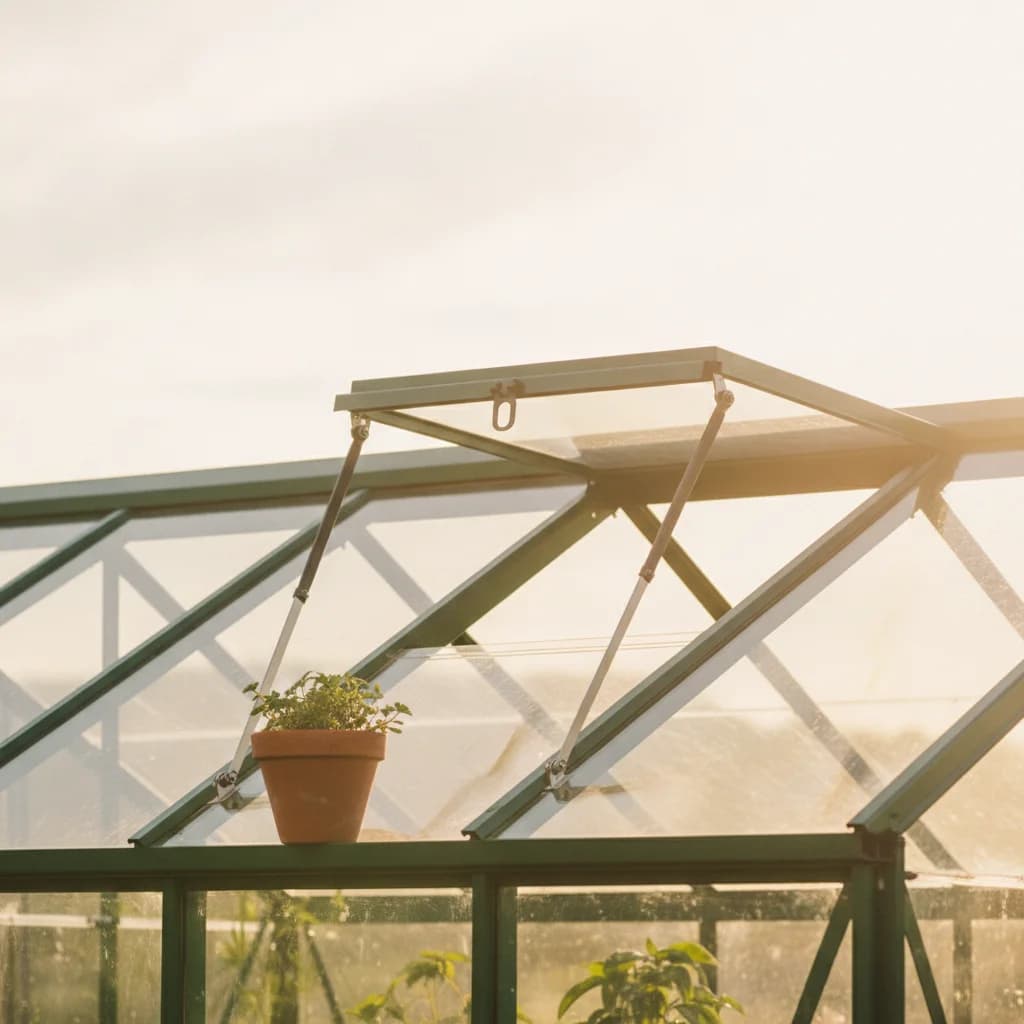
A greenhouse with too little vent area can exceed 95F on a sunny summer day. Purdue Extension says heat damage and flower drop can begin above 90F, so plants can be in trouble well before the greenhouse reaches its daily peak. The fix is enough high and low vent area, plus automatic openers when nobody will be there at midday.
This page carries no product links and no ranking. It is horticultural-loss guidance, served straight, so you can set the greenhouse up to protect the plants you put in it. Where ventilation sits in the whole budget is in the real cost of a greenhouse, and how glazing choice affects heat gain is in glass vs polycarbonate.
Quick Answer: Vent Area Plus Auto Openers
Two things prevent the cook.
- Enough vent area. University of Alaska Fairbanks recommends combined ridge and side openings equal to 20 to 30 percent of floor area for a home greenhouse. UConn's summary of ASABE guidance calls for roof vents equal to 15 to 20 percent of floor area and sidewall vents equal to another 15 to 20 percent.
- Automatic vent openers. Wax-cylinder devices that open and close the roof vents on temperature, with no electricity and nothing to plug in. They act at midday whether you are home or not.
That combination is the difference between a greenhouse that breathes and one that becomes an oven the first hot afternoon. A door propped open by hand is not a ventilation system, because it is only open when you are standing there.
Why It Gets So Hot So Fast
A greenhouse is built to retain solar heat, which is useful in spring and fall and dangerous in summer. Sun comes through the glazing, warms everything inside, and the enclosure slows that heat from escaping. Purdue Extension says a greenhouse can easily exceed 95F in summer, while many plants grow best around 68 to 78F and can suffer heat damage and flower drop above 90F.
The cruel part is the timing. The greenhouse peaks around midday, exactly when most people are away. You leave in the morning with the plants fine and a mild forecast, the sun comes out, and you come home to cooked seedlings. This is not a rare event. It is the classic first-summer mistake, and it is why "I cooked everything in one afternoon" is one of the most common greenhouse regrets there is.
How Much Vent Area You Need
There are two useful published benchmarks, and they should not be collapsed into one smaller number. University of Alaska Fairbanks recommends combined ridge and side openings equal to 20 to 30 percent of floor area for a home greenhouse. UConn reports ASABE guidance of roof vents equal to 15 to 20 percent of floor area plus sidewall vents equal to another 15 to 20 percent.
For an 8 by 12 greenhouse, the floor area is 96 square feet. The home-greenhouse rule gives about 19 to 29 square feet of combined opening. The ASABE approach gives about 14 to 19 square feet at the roof and the same again at the sidewalls, about 29 to 38 square feet in total.
The number most cheap kits ship with is nowhere near this. A single small roof vent on a flat-pack greenhouse might be a few square feet, a fraction of what the floor needs, which is a large reason those kits cook plants. If the greenhouse you are looking at does not state its vent area, work it out from the vent sizes, and be ready to add vents.
Placement does half the work. Put vents high in the roof and low in the sides or as louvers near the ground. Hot air rises and leaves through the roof vents, which pulls cooler air in through the low vents, and the greenhouse ventilates itself with no fan. Two openings at the same height do not do this. High-out, low-in is the pattern that moves air.
Automatic Vent Openers: Not an Accessory
The single most useful thing you can add to a greenhouse is a set of automatic vent openers, and most buyers underrate them until the first hot day. If vents alone cannot hold the temperature in high summer, shade cloth is the next lever.
They are simple. A sealed cylinder of wax expands as it warms and pushes the roof vent open, then contracts and closes it as things cool. No electricity, no sensor, no wiring, nothing to plug in. They act on temperature at midday whether or not anyone is home, which is the whole point, because the greenhouse overheats fastest on the days nobody is there.
Fit one opener per compatible roof vent and follow the opener and greenhouse makers' weight, travel, and installation limits. Check that every vent moves freely before the hot season. An opener cannot compensate for a jammed hinge or for too little total vent area.
The Rest of the Summer Toolkit
Vents and openers do the core job. In hot climates or a heatwave, a few more things help.
- Shade cloth over the roof in high summer cuts the solar gain that drives the temperature up, and comes off again in fall.
- Damping down, wetting the floor on hot mornings, cools the air a little as the water evaporates and raises humidity for the plants.
- A max-min thermometer tells you the truth about how hot it actually got while you were out, so you can size the fix to the real number rather than a guess.
- A powered exhaust fan is worth it in the hottest regions or a large greenhouse where passive venting cannot keep up, and it needs power run to the structure, which is a budget line covered in the real cost of a greenhouse.
Size and glazing feed into all of this. A larger greenhouse and clearer glazing both change how much you have to vent, and what size greenhouse do I need covers the sizing side.
The Other Structural Failures, in Order
Overheating is the failure that kills the most plants, but it is one of four worth reading together, because a greenhouse has to survive the weather as well as the sun.
The shortlist that gets ventilation right out of the box is in best greenhouses, and the "I wish someone had told me" stories, overheating high among them, are in greenhouse buying regrets.
Frequently Asked Questions
Why is my greenhouse so hot it is killing my plants?
The enclosure is collecting solar heat faster than it can release it. Purdue Extension says a greenhouse can easily exceed 95F in summer, while heat damage and flower drop can start above 90F. Add enough high and low vent area, make sure the openings are unobstructed, and use automatic openers so the roof vents act before the daily peak.
Did you get the automatic openers?
If nobody will be beside the greenhouse every sunny midday, automatic openers are the reliable choice. Wax-cylinder models need no electricity and respond directly to temperature. They do not replace adequate vent area, but they make sure the roof vents actually open when the greenhouse needs them.
How much ventilation does a greenhouse need?
For a home greenhouse, University of Alaska Fairbanks recommends combined ridge and side openings equal to 20 to 30 percent of floor area. UConn's summary of ASABE guidance calls for 15 to 20 percent at the roof plus another 15 to 20 percent at the sidewalls. For an 8 by 12 greenhouse, those methods produce roughly 19 to 29 square feet total, or 29 to 38 square feet total respectively.
Can I just leave the greenhouse door open all day?
An open door helps a little but does not replace real venting, because one low opening does not move air the way high-out, low-in vents do, and the door is only open when you are home. The greenhouse peaks around midday, often when you are away, so you need vents that act on their own. Fit roof vents with automatic openers and low side vents, and use the door as extra airflow, not as the whole plan.
How hot is too hot inside a greenhouse?
Crop needs vary, but Purdue Extension says most plants grow best around 68 to 78F and that heat damage and flower drop can occur above 90F. A max-min thermometer will show whether your current ventilation keeps the greenhouse below damaging peaks.
Sources