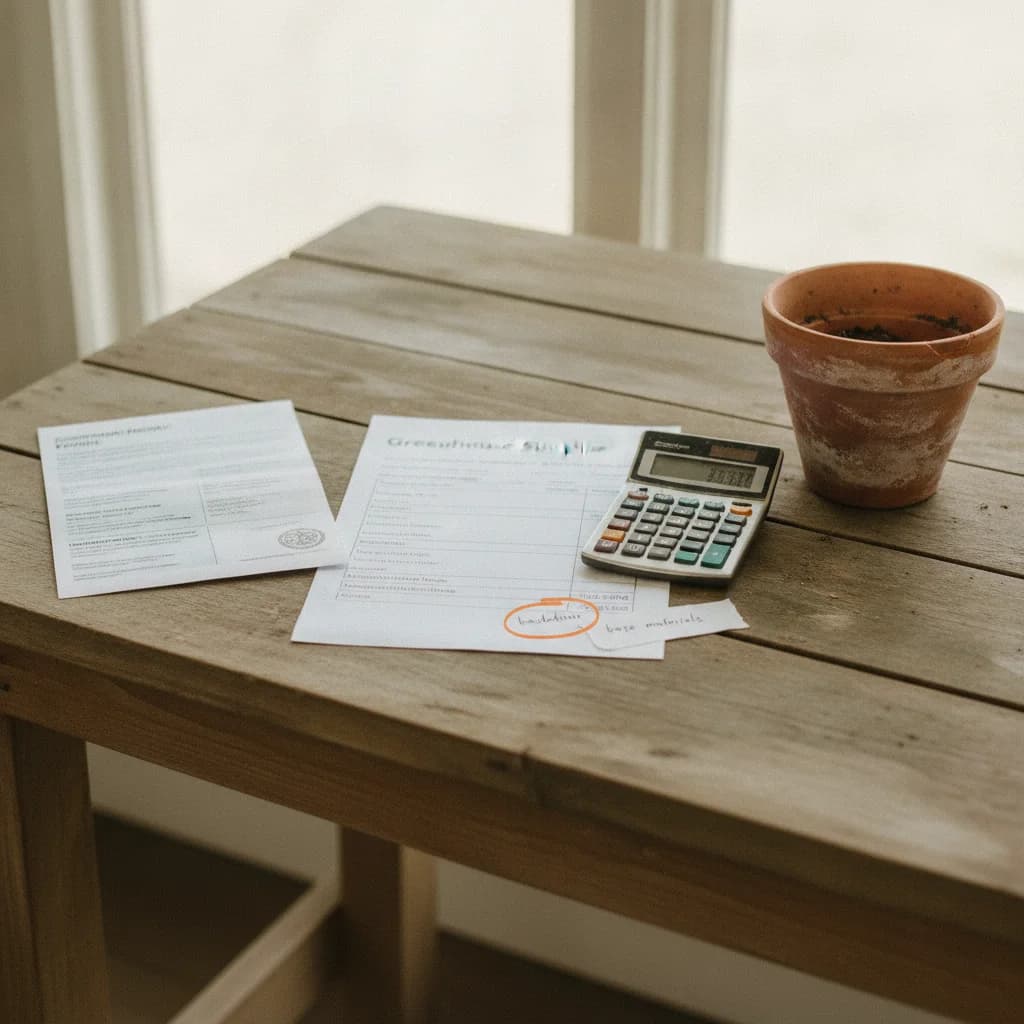
Build a complete $5,000 to $20,000 greenhouse budget. Named product subtotals, address-specific gaps, and every line to close before the deposit.
Budget
Quick answer: A $5,000 to $20,000 greenhouse budget is complete only after the exact structure, factory base, site work, anchoring, vents, delivery, tax, labor, utilities, heater, permit, first-winter energy, and contingency all have numbers. At roughly 100 square feet, source-dated DIY build subtotals are $3,750 to $7,400 for a Palram Glory 8x12, $8,800 to $10,800 for a Riga 3, and $10,500 to $12,800 for a Janssens Junior Victorian 24. Those are not address totals. No model-specific paid-assembly price was published for the Junior. Subtract the remaining local lines from your hard ceiling before you place the deposit.
Best for
Buyers pricing a greenhouse before they request a quote, so the final number holds no surprises once the base and vents are counted.
Wrong fit
Buyers who already have the full installed budget set and just want a brand shortlist.
Tradeoff
Spending more on the structure leaves less room for the site, delivery, utilities, and first winter. A stronger kit that pushes the finished project past the hard ceiling is still the wrong buy.
A $10,000 budget is not permission to buy a $10,000 kit. The real greenhouse cost is the finished project, and the structure is only the number the product page shows you. The finished project also needs a level site, the right base, anchoring, enough ventilation, delivery, tax, labor, and whatever your permit, power, water, and winter plan require. The kit price is not the project price.
That gap is the whole reason this page exists. We don't sell greenhouses. We save you from buying the wrong one, and the fastest way to get burned is to price the pretty structure and forget everything that holds it down and keeps it from cooking your plants. This guide prices the whole project, premium glass and mid-market polycarbonate both. With the budget set, the step-by-step path from lane to signed quote is the full greenhouse buying guide.
If you are still deciding between glass and polycarbonate, read glass vs polycarbonate first, because that one choice moves your budget and your light quality more than the brand does. If you are not sure how big to go, what size greenhouse do I need is the other decision that changes the number.
Quick Answer: A Complete $5,000 to $20,000 Budget
These are not four prettier kit prices. They are four hard ceilings. The build subtotal covers the exact model, ground base, site preparation, anchoring, and the ventilation allowance documented in Palram vs Riga vs Janssens. The money left must cover every address-specific line that comparison cannot know: delivery, sales tax, permit, power, water, heat, and contingency.
Hard ceiling
Candidate structure lane
Source-dated build subtotal
Money still available for every address-specific line
Deposit decision
$5,000
Palram Canopia Glory 8x12, only if the local build lands at the bottom of its range
$3,750 to $7,400
$1,250 at the low end. The high end misses the ceiling by $2,400
Stop unless written local numbers fit inside $1,250. A $5,184 dealer kit alone does not fit this plan
$10,000
Palram with room to close local gaps, or Riga 3 only at the low end
Riga 3: $8,800 to $10,800
$1,200 at the low end. The high end already misses by $800
Do not call the Riga a $10,000 project until delivery, tax, utilities, heat, and permits total $1,200 or less
$15,000
Janssens Junior Victorian 24 DIY
$10,500 to $12,800
$2,200 to $4,500
DIY can fit. Paid assembly is unverified for this model and needs a fixed Junior-specific quote
$20,000
Janssens Junior Victorian 24 DIY, with room to price labor
$10,500 to $12,800
$7,200 to $9,500
Require a fixed Junior-specific assembly quote, then fit that quote and every address-specific line inside the remaining balance
The subtraction is deliberate. A Riga 3 subtotal of $8,800 inside a $10,000 ceiling leaves $1,200, not an invisible second budget. A Janssens DIY subtotal of $12,800 inside a $20,000 ceiling leaves $7,200 before assembly and the other local lines. If the address-specific lines cost more, the model does not fit the budget. Do not solve that by deleting the line.
The Checklist That Makes the Number All-In
Cost line
What closes it
When $0 is documented
Structure and selected options
Dated cart or written seller quote for the exact SKU
Never
Factory base or foundation frame
Packing list and model specification
Only when explicitly included
Ground base, drainage, and site preparation
Materials cart or local contractor quote from the maker's foundation drawing
Only when a suitable, documented base already exists
Anchoring and fixings
Anchor schedule matched to the base and local design conditions
Never
Roof vents, low inlets, shade, and controls
Vent-area check plus current component prices
Only when the shipped system already meets the chosen plan
Freight, liftgate, placement, and damage handling
Written delivery quote to the address
Only when the seller confirms it in writing
Sales tax
Checkout or seller quote
Only where the transaction is legally untaxed
Assembly labor
Fixed local or manufacturer quote
When the buyer has chosen and can complete DIY assembly
Power, water, and trenching
Licensed-trade quote or an explicit off-grid, hose-only plan
When the relevant authority confirms no fee or approval
Contingency
Money left after every line above
Never on an unfinished site
The budget is closed when every row has a written number or a deliberate, defensible $0. If one row still says “probably included,” the total is not all-in.
What This National Budget Cannot Verify
Final delivery, liftgate, placement, sales tax, and damage-handling cost for your address
Excavation, drainage, concrete, masonry, power, water, and assembly labor on your site
Permit, inspection, HOA, setback, and utility requirements in your jurisdiction
The first winter's heater runtime before the exact greenhouse, target temperature, and climate are known
A paid-assembly price for Palram Glory, Riga 3, or Janssens Junior Victorian 24. Owner reports for larger Royal Victorian models do not price the Junior
Those are not small-print extras. They are the numbers that decide whether a $10,000 or $20,000 ceiling holds.
The Responsibility Matrix Most Quotes Leave Out
Scope
Usually owns it
What to verify
Structure, glazing and options
Manufacturer
Exact included components, freight and warranty
Foundation, slab or dwarf wall
Buyer and local contractor
Drawings, tolerances, drainage, inspection and sign-off
Structure assembly
Manufacturer or local installer
Crew scope, access, schedule, completion and exclusions
Electrical, water and heating
Licensed local trades
Trenching, equipment, code, controls and commissioning
Permits, HOA and setbacks
Buyer with local professionals
Approval before ordering, plus wind and snow criteria
Final scope reconciliation
Buyer
One named owner beside every cost line before the deposit
If you are planning an installed glasshouse rather than a kit, use the Premium Greenhouse Project Brief. It keeps every unknown line visible and separates the structure budget from the finished project budget.
Still choosing whom to ask for that installed proposal? Compare six residential greenhouse builders by service reach, crew model, foundation scope, engineering, and public price signal before you request quotes.
Already have a seller number? Run every responsibility above through the 21-line greenhouse quote checklist. A single “shipping included” line is not enough unless it also says curbside or placed delivery, who inspects, and who owns a damage claim.
The Base Is the Line Everyone Under-Budgets
A greenhouse needs a level, drained, square base, and that base decides whether the structure lasts or racks itself apart. This is the single most under-budgeted line item in the whole project, and it is the first place a cheap quote hides.
You have three base options, and they price very differently:
Gravel and timber. A compacted crushed-stone bed inside a pressure-treated or steel perimeter. It drains well, is DIY-friendly, and suits most mid-market kits. Close the number with a materials cart for the exact footprint and depth.
Concrete slab. The strongest base, with good pest and rot resistance. It is the right call for a heavy glasshouse or difficult ground when the manufacturer and local professional agree. Close it with the maker's drawing and a local quote that states excavation, sub-base, reinforcement, drainage, concrete, access, and finishing.
Brick or block dwarf wall. The premium base under a glass house. It raises the glazing off the ground and suits an heirloom structure, but it needs a project-specific masonry quote rather than a national allowance.
Sloped, soft, or poorly drained ground adds real cost before the first pane goes up. The full breakdown, and how to tell which base your greenhouse actually needs, is in the foundation and base guide.
Anchoring: The Cheapest Line That Prevents the Worst Failure
An unanchored greenhouse is a kite. This is the most common catastrophic failure, and it is almost never on the quote. Proper anchoring, base fixings into the slab or ground anchors into a gravel-and-timber perimeter, is cheap compared to replacing a whole structure the wind folded across your yard. Budget it as a real line, question any quote that leaves it out, and read wind and anchoring before you decide the base. That page sells nothing. It is life-of-the-structure guidance, served straight.
Ventilation: The Line That Decides Whether Your Plants Survive July
Overheating kills more plants than cold does. A greenhouse with too little vent area and no automatic openers cooks everything inside on the first hot afternoon while you are at work. Passive roof vents alone are rarely enough.
The rule of thumb from the ASABE is total vent area equal to 15 to 20 percent of the floor area, inlet and outlet combined. Automatic vent openers are wax-cylinder devices that open and close on temperature with no electricity. Greenhouse Megastore listed an AutoVent at $59.99 and a Bayliss opener at $97.50 on August 31, 2026. The count and compatible bracket still depend on the greenhouse. On any greenhouse you will not be standing next to at 11am on a July day, auto vents are not an accessory, they are the thing that keeps the plants alive. The full failure mode and the fix are in ventilation and overheating. After that non-commercial safety decision is settled, the accessories hub shows current prices and compatibility for monitoring, openers, shade, irrigation, fans, and heat.
Kit Sticker vs Real Project
What the product page shows
What the project actually costs
The kit or structure price
The kit plus base, anchoring, vents, and utilities
One clean "from" number
A figure that moves with your ground and your climate
Glazing and frame
Site prep, a permit check, and assembly labor on top
Current Sticker Prices Under $20,000
These manufacturer prices were checked August 31, 2026. They prove what the structure was listed for, not what your finished project will cost.
Exact model
Current structure price
Availability and scope boundary
Planta Sungrow Compact Gen III
$2,550
Current US collection showed sold out. Base, vents, tax, assembly, and address-specific freight are extra
Planta Sungrow 20 Gen III
$4,250
Current US listing showed sold out or backorder. Base, vents, tax, and assembly are extra
Yoderbilt Legacy 8x12
$5,495
Structure arrives assembled. Pad, address access, options, delivery area, and tax still need written numbers
Exaco Riga 3
$6,899
The $1,299 factory foundation frame is separate, before the ground base and site work
Janssens Junior Victorian 24
$9,599
Factory base frame is included. Ground foundation, intake ventilation, site work, and assembly are separate
The verified build subtotals in the hard-ceiling table add the documented base, site, anchor, and ventilation planning ranges for comparable roughly 100-square-foot projects. The sticker-price table does not. Use it to catch a seller-price change, then close every row in the all-in checklist.
Heating, Power, and Water: Budget Before You Buy, Not After
If you want to grow past the first frost, heating has two lines: the equipment and safe hookup now, then energy every time the thermostat calls for heat. Planta's official pages list the same 2,800-watt Phoenix heater/cooler at $299 and $315, both sold out, before any new 240 V circuit, trench, thermostat, or licensed electrical work. Treat that spread as a dated equipment signal, not an orderable quote. At the US Energy Information Administration's August 2026 residential forecast of 18.3 cents per kWh, the heater costs about 51 cents for each full-load hour. That is a calculation, not a monthly prediction. The runtime table and the rest of the four-season ownership budget are in greenhouse heating and running costs, but check season extension in a greenhouse first. Thermal mass and a row cover can extend the season before a heater budget is needed.
Permits, HOA, and Setbacks: The Line That Stops the Project
This one varies too much for a national price, so do not invent an allowance. Keep the line as TBD until the local building department confirms the fee and process in writing, then replace it with the real number. A poured base or utility connection can change the review even when the structure alone would be exempt. Setbacks, easements, and HOA rules can stop the location without charging a permit fee at all. Check before ordering, then use the permit guide to ask the right local questions.
How to Budget by Your Lane
Buying a premium glasshouse to keep for 20 years? You are pricing a project that starts in the mid five figures for the heirloom names, with Alitex's entry Kew at $61,500 delivered and installed and Hartley quoted per project, not an $8,000 kit. The real Hartley figures, dated and sourced, are assembled in what a Hartley Botanic actually costs. Budget the base, the masonry or slab, the anchoring, the auto vents, and professional assembly, then get two or three quotes after a site visit. The head-to-head that matters most is Hartley Botanic vs Alitex, and the wider field is in best greenhouses.
Stepping up from a cheap kit to something that lasts? You are the mid-market buyer. At roughly 100 square feet, the source-dated build subtotal is $3,750 to $7,400 for the Palram Glory 8x12 and $8,800 to $10,800 for the Riga 3 before the address-specific rows are closed. A Palram/Canopia, Yoderbilt, or Solexx twin-wall does the real work of seed-starting and overwintering for a fraction of the heirloom glass number, and that is a smart buy, not a compromise. Start with best polycarbonate greenhouses.
Actually want a heated room to work or read in year round? That is not a greenhouse, it is an office pod, and a greenhouse will disappoint you as a four-season room. We say so plainly. Weigh it at backyardoffice.guide before you spend greenhouse money on the wrong structure.
Whichever lane fits, price the whole project before you fall for a photo. The base, the anchoring, and the ventilation are the parts that decide whether you own a greenhouse in ten years or a story about the one that blew away.
Frequently Asked Questions
My dream greenhouse 😍, I wonder how much it would cost to build something like this?
Start by naming the lane and the hard ceiling. At roughly 100 square feet, the source-dated build subtotals are $3,750 to $7,400 for a Palram Glory 8x12, $8,800 to $10,800 for a Riga 3, and $10,500 to $12,800 for a Janssens Junior Victorian 24 DIY. Those still need the address-specific rows closed. The photograph gives you the structure. The address and ownership plan give you the price.
What is the cost of this greenhouse?
The only useful answer is a line-item total for the exact model and address. Ask for the structure, glazing, freight, delivery type, base, anchors, vents, assembly, utilities, heat, permits, tax, and warranty responsibilities separately. If a seller gives one number without those lines, run it through the greenhouse quote checklist before paying.
Is it worth the investment (initial cost + electric heating) or would it be better to just use the grow lights I already have in the basement?
Use the basement if the real goal is only to keep tender plants alive or start seedlings cheaply. A greenhouse earns the investment when you also want more growing area, natural light, season extension, and a permanent garden structure. Price winter heat from heater input, the UGA heat-load method, full-load runtime, and your electricity rate. The heating and running-cost guide shows the calculation instead of assigning an unsupported national monthly range.
Can anyone speak to if they think Hartley is worth the huge cost difference compared to a like sized Janssen brand greenhouse?
Hartley earns the difference for a buyer who wants a bespoke heirloom glasshouse, professional project delivery, and a structure that belongs in a formal garden for decades. Janssens is the reachable glass choice when you accept a kit or paid local assembly. They grow the same plants. The extra money buys design, finish, project service, and long-term ownership, not better tomatoes.
These guides are built from manufacturer documentation, public specifications, primary research where health claims matter, and repeated buyer questions that show up in real ownership and installation decisions.
Manufacturer responses can clarify pricing bands, warranty terms, support footprint, or common mistakes. They do not move a page up the shortlist on their own.