Gravel-and-timber, concrete slab, or brick dwarf wall? The base runs $500 to $5,000 and decides whether the greenhouse lasts. The full cost breakdown.
Installation
Quick answer: A greenhouse needs a level, drained, square base, and it is the single most under-budgeted line in the whole project, running $500 to $5,000 or more. Gravel-and-timber ($1 to $3 per square foot in materials) drains well, is DIY-friendly, and suits most mid-market kits. A concrete slab ($3 to $6 per square foot) is the strongest base, best for heavy glasshouses and soft ground, and will not shift or need re-leveling for 25-plus years. A brick or block dwarf wall is the premium base under a glass house, several thousand dollars built by a mason. The base is also what you anchor to, so it decides whether the greenhouse survives a storm.
Best for
Buyers pricing the base before they order the greenhouse, so the most under-budgeted line is a real number, not a surprise.
Wrong fit
Buyers who have not chosen a greenhouse yet. The kit weight and glazing decide which base you need, so pick the lane first.
Tradeoff
Gravel-and-timber is cheap, drains well, and DIY-friendly but less permanent. Concrete and dwarf walls cost more and want a pro, but they never shift and they anchor a heavy glasshouse for decades.
The base is the line nobody budgets and everybody needs. A greenhouse has to sit on something level, drained, and square, and that base runs $500 to $5,000 or more depending on which type you choose. It is the single most under-budgeted item in the whole project, and it is the first thing a cheap quote leaves off. Get it wrong and the frame racks, panes crack, and the structure has nothing solid to anchor against. What goes on top of the base, the flooring and the drainage, is its own decision, covered in the flooring and drainage guide.
We don't sell greenhouses. We save you from buying the wrong one, and skipping the base is how a good greenhouse becomes a leaning, leaking one. This guide prices the three main base options and tells you which your greenhouse actually needs.
The base is also where the budget quietly moves, so read it next to the real cost of a greenhouse. And because the base is what you anchor to, pair it with wind and anchoring, which is served straight as life-of-the-structure guidance.
Quick Answer: The Three Base Types
Base type
Cost (materials)
Best for
Drainage
Permanence
DIY?
Gravel and timber
$1-$3 / sq ft
Most mid-market kits, seed-starting
Excellent
Good, re-level occasionally
Yes
Concrete slab
$3-$6 / sq ft
Heavy glasshouses, soft/sloped ground
Needs a fall or drain
25+ yrs, never shifts
Possible, often pro
Brick / block dwarf wall
Several thousand+
Premium glass houses
Good
Decades, heirloom look
No, mason work
Bare ground / paving slabs
Cheapest
Not recommended
Poor
Racks and shifts
Yes, but skip it
Costs are typical US material ranges and worth verifying at write time. A professional pour or a mason adds labor well above the material number, and sloped or soft ground raises every option.
Gravel and Timber: The Right Base for Most Kits
For most mid-market greenhouses, a gravel-and-timber base is the right answer. You build a level perimeter of pressure-treated timber or a steel base kit, then fill it with compacted crushed stone. It costs roughly $1 to $3 per square foot in materials, drains beautifully so the interior never puddles, and a competent DIYer can build it in a weekend. On an 8x12 footprint that is a couple hundred dollars in stone plus your labor.
The fit statement: for a Palram/Canopia, a delivered Yoderbilt, or a Solexx used for seed-starting, propagation, and season extension, this base does everything you need and anchors well with ground anchors or the manufacturer's base fixings. The caveat: it is less permanent than concrete and may need occasional re-leveling as the ground settles, and it is not the base for a heavy glass house. For the mid-market lane, though, it is not a compromise, it is the smart choice.
Concrete Slab: The Strongest Base
A full concrete slab is the strongest, most permanent base, roughly $3 to $6 per square foot, more with rebar and a professional pour. It offers the best pest resistance (nothing tunnels up through it), the best heat retention, and it will not shift, rot, or need re-leveling for 25-plus years. For a heavy glasshouse, for soft or sloped ground that a gravel base would not hold, or for a greenhouse you want dead-level for decades, the slab earns its cost.
The caveats: a solid slab must be laid with a slight fall or a drain, because water has to go somewhere and a perfectly flat slab puddles. It is also less forgiving to get wrong, a poured slab that is out of level or out of square is an expensive mistake to fix. Many buyers can pour a small slab themselves, but a large or critical one is worth a professional. If you are putting real money into the greenhouse, do not save it on the slab.
Brick or Block Dwarf Wall: The Premium Base
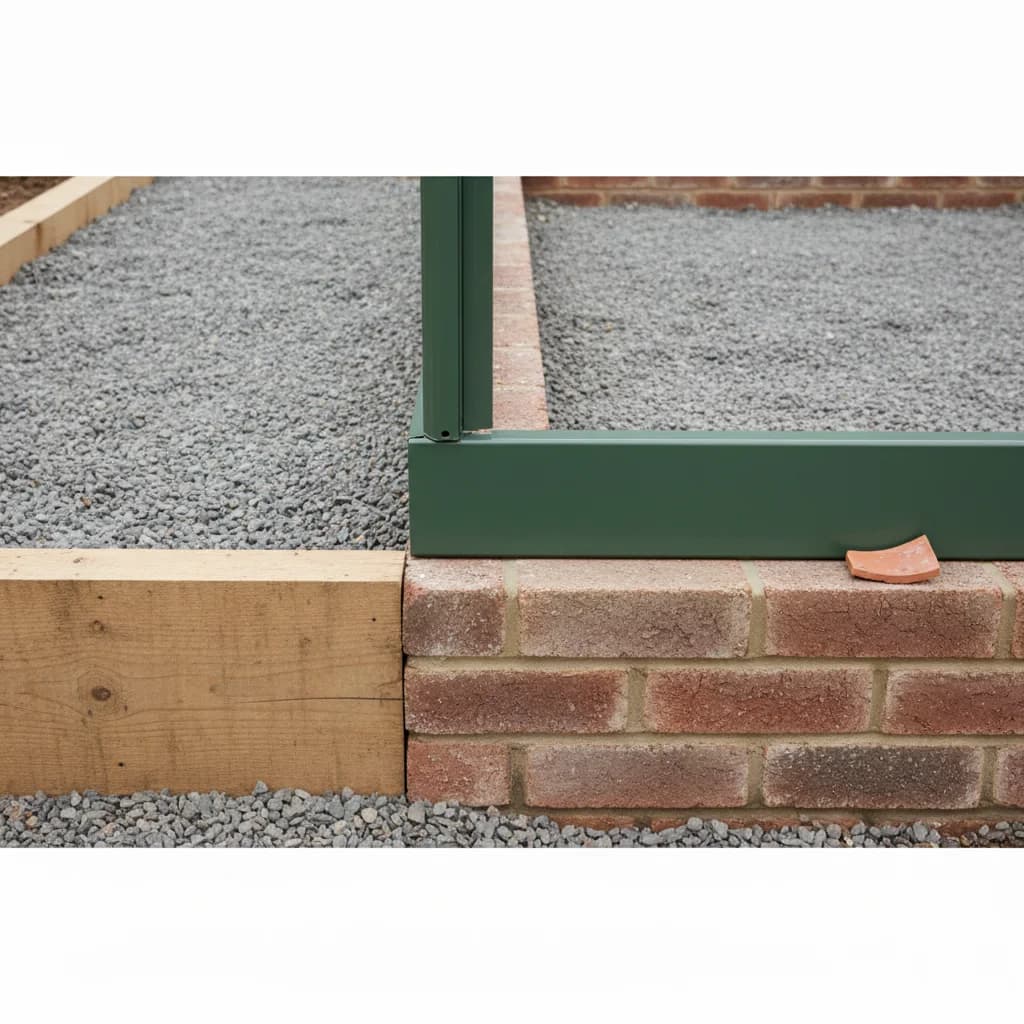
A dwarf wall is a low masonry wall, typically a concrete footing with a couple of courses of brick or block, that the greenhouse frame sits on top of. It is the premium base under a glass house and it costs the most by a wide margin, several thousand dollars, because it is mason work on top of a proper footing. What it buys you: it looks the part under a Hartley, an Alitex, or a Janssens, it raises the glazing off the cold and splash of the ground, and it can add insulation and a solid mounting for staging. It is the heirloom base for the heirloom greenhouse.
The caveat is simply cost and commitment. This is not a DIY line and it is not reversible, so it is for the buyer who is building a permanent glasshouse and wants it to look and last accordingly. If that is you, budget it into the Hartley or Alitex project from the start, since premium brands quote the structure and leave the base to you.
Why the Base Decides the Lifespan
Every base does two jobs: it keeps the greenhouse level and square so the frame does not rack and the glazing does not crack, and it gives the structure something solid to anchor to against wind. An unanchored greenhouse is a kite, and you cannot anchor properly to nothing. A greenhouse on bare grass or loose paving slabs shifts, twists, and hands the wind a way to lift it. That is why the base is not the place to save money, it is the place that decides whether you own a greenhouse in ten years. Get the base and the anchoring right together, from wind and anchoring.
How to Choose Your Base
Mid-market polycarbonate kit for growing? Gravel-and-timber, almost always. Cheap, drains well, DIY-friendly, and correct for the lane. See best polycarbonate greenhouses.
Heavy glass house, soft ground, or a house you want dead-level for decades? Concrete slab, laid with a fall or a drain, professionally poured if it is large or critical.
Premium glasshouse you are building to keep and to look the part? A brick or block dwarf wall, budgeted into the project from the start. See best greenhouses.
Building on a slope or unsure the ground drains? Get the site leveled and drained first, whatever base you choose, because sloped and soft ground raises every option and a base built on bad ground fails no matter the material.
Whatever you choose, price the base for your actual footprint before you order the greenhouse, and check your permit and setback rules, since a permanent base can trigger both. Start with do I need a permit for a greenhouse and the full budget in the real cost of a greenhouse.
Frequently Asked Questions
Can I just put my greenhouse on grass or paving slabs?
You can, and it is the most common way a greenhouse ends up leaning and leaking. Grass and loose paving shift and settle, so the frame racks out of square, panes crack, and there is nothing solid to anchor to against wind. At minimum a mid-market kit wants a level gravel-and-timber base. Save the shortcut for a cold frame, not a greenhouse you paid real money for.
What is the cheapest base that actually works?
Gravel-and-timber, at roughly $1 to $3 per square foot in materials. You build a level pressure-treated or steel perimeter and fill it with compacted crushed stone. It drains well, anchors fine, and a DIYer can do it in a weekend for a couple hundred dollars on a typical hobby footprint. It is genuinely the right base for most mid-market greenhouses, not just the cheap one.
Do I need a concrete slab for my greenhouse?
Only for some. A slab is the strongest, most permanent base and it makes sense for a heavy glass house, for soft or sloped ground a gravel base would not hold, or when you want the interior dead-level and pest-proof for 25-plus years. It runs $3 to $6 per square foot and must be laid with a slight fall so it drains. For a light polycarbonate kit used for growing, a gravel-and-timber base usually does the job for far less.
How much should I budget for the base?
Anywhere from $500 to $5,000 or more, which is exactly why it is the most under-budgeted line. A DIY gravel base on a small kit can be a couple hundred dollars, a professionally poured slab runs into the low thousands, and a masonry dwarf wall under a glasshouse is several thousand. Sloped or soft ground raises all of them. Price it for your real footprint before you order, because the greenhouse quote almost never includes it.
Does the base need to drain?
Yes, and it is where a lot of bases go wrong. Water has to get away from the greenhouse or the interior puddles and the base stays wet. Gravel drains naturally, which is one of its strengths. A concrete slab must be poured with a slight fall or an internal drain, because a perfectly flat slab holds water. Whatever base you build, plan where the water goes before you build it.
Is the base what I anchor the greenhouse to?
Yes, and that is one of its most important jobs. Anchoring is what keeps a greenhouse from becoming a kite in a storm, and you can only anchor properly to something solid: base fixings into a slab, ground anchors into a gravel-and-timber perimeter, or bolts into a dwarf wall. A greenhouse on bare ground has nothing to hold it down. Get the base and the anchoring right together, covered straight in wind and anchoring.
Methodology
These guides are built from manufacturer documentation, public specifications, primary research where health claims matter, and repeated buyer questions that show up in real ownership and installation decisions.
Manufacturer responses can clarify pricing bands, warranty terms, support footprint, or common mistakes. They do not move a page up the shortlist on their own.