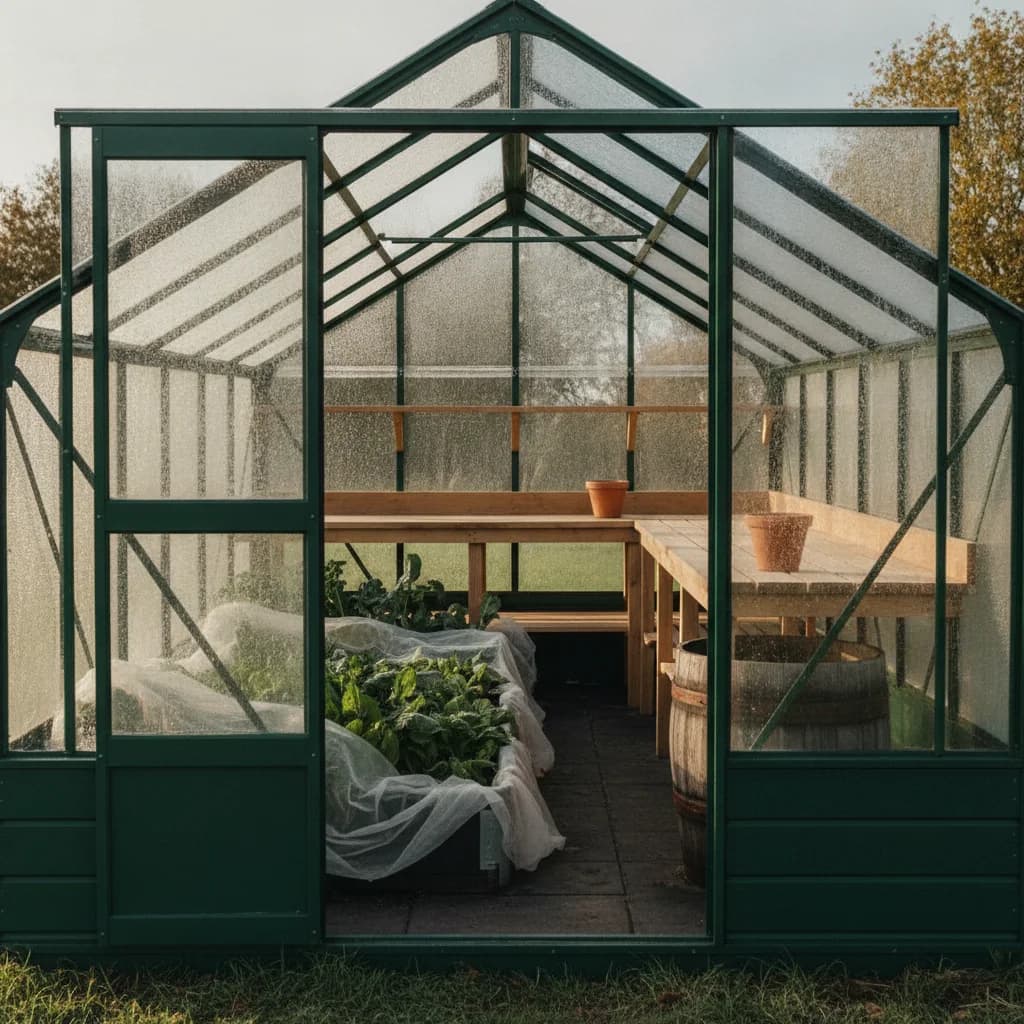
Greenhouse Season Extension: Unheated Growing Weeks
An unheated greenhouse can add 4 to 8 weeks at each end of the season, not a full winter. See what passive protection buys and when heat is worth the cost.
Installation
Quick answer: An unheated greenhouse typically stretches the growing season 4 to 8 weeks on each end for cold-hardy crops like lettuce, spinach, kale, and root vegetables, not a full winter of warm-season growing. The structure alone is not reliably warmer than outside air: on a clear, calm night it can trap cold air and run colder than the yard until thermal mass or a row cover is added. Passive tools, thermal mass, an inner row cover, and tight sealing, buy real weeks. Growing tomatoes or peppers through a hard winter is a heating-cost decision, not a season-extension trick.
Best for
Greenhouse owners and near-term buyers deciding how far they can push fall and winter growing before they need to spend on a heater.
Wrong fit
Buyers who already plan to heat for warm winter growing. Go straight to the heating-cost numbers instead.
Tradeoff
Passive season extension is free or cheap and genuinely buys weeks. Growing warm-season crops through a real winter needs heat, and that turns a hobby into a monthly bill.
Most buyers picture a greenhouse as a warm bubble that pushes the growing season deep into winter for free. It does not work that way. An unheated structure buys real weeks, not months, and on the wrong kind of night it can be colder than the yard, not warmer.
We don't sell greenhouses. We save you from buying the wrong one, and season extension is where expectations quietly outrun physics. This page separates what an unheated or lightly protected greenhouse actually gets you from what needs real heat, using published university extension figures instead of catalog-photo optimism. If you have already decided to heat through winter, skip straight to greenhouse heating cost for the monthly numbers.
Quick Answer: What Each Layer of Protection Buys You
Protection
Effect
Realistic season gain
Bare unheated structure, no thermal mass
On sunny days, real heat gain. On clear, calm nights, can run 2.5F to 10F colder than outside air because it traps cold air (University of Maryland Extension)
Unreliable alone
Structure plus thermal mass (water barrels, brick, gravel)
Stores daytime heat, releases it overnight, smooths the swing
Adds real frost buffer, the baseline worth having
Structure plus an inner row cover or low tunnel
Row covers and low tunnels add about 4-5F of frost protection on their own (NC State Extension); a heavy row cover can protect down to roughly 20F outside (UMN Extension)
Supports tomatoes, peppers, and tropicals through winter
This is no longer season extension, it is a $100-800+/month running cost by size and glazing
These are ranges from published extension guidance and this site's own heating-cost figures, not a guarantee for your exact site, latitude, and cloud cover. For a U.S. site, check your local frost dates and typical winter lows before planning around any of them.
The Counterintuitive Part: Unheated Does Not Always Mean Warmer
Most greenhouse copy assumes the glazing itself buys you heat. University of Maryland Extension documented the opposite case: a small unheated high tunnel ran 2.5F colder than outside air with the sides open, 5F colder with small vents open, and up to 10F colder fully sealed, on clear, calm nights. The plastic was trapping a pool of cold air rather than holding daytime warmth, and a small structure heats and cools faster than a large one. The fix the extension expert gave was thermal mass, water barrels or a brick path, to absorb daytime heat and give it back overnight.
The takeaway for a buyer: glazing alone is not a heating system. A greenhouse extends your season because of what you put inside it and how you manage it at night, not just because it has walls. This is exactly why glass vs polycarbonate matters for more than looks, better insulation gives thermal mass and row covers something to work with instead of leaking it straight back out.
Two Different Goals, Not One
Extension research on unheated hoop houses (Michigan State University) draws a useful line between two strategies that get lumped together as "season extension":
Winter production. Cold-hardy crops planted in late summer and harvested straight through winter, with tender varieties done by around mid-December and hardier ones like spinach and kale holding into February under protection.
Overwintered production. Crops seeded in fall, allowed to go dormant through the coldest months, then resuming growth in spring to mature roughly three to six weeks earlier than a spring sowing would.
That research describes a Michigan farm trial in unheated hoop houses, not a backyard greenhouse, but the framework transfers: decide up front whether you want to eat from the greenhouse all winter or just get a spring head start, because the planting dates and crop choices are different.
There is also a third winter goal that is not season extension at all: keeping tender plants alive until spring. That job has its own temperature floors per species and its own heating math, covered in overwintering in a greenhouse.
Timing and Crop Choice
Colorado State University Extension puts hard numbers on what a hobby greenhouse can actually finish. Cool-season crops do well at 50-70F during the day and 45-55F at night, and can tolerate short-term swings from 35F to 90F. Warm-season crops need 60-85F days and 55-65F nights and are not cost-effective to grow through winter without supplemental heat, full stop.
Because winter light is weak, Colorado State's guidance is to have winter crops near harvest size by mid-October, not started from seed in November hoping they catch up. Leafy greens (lettuce, spinach, kale, chard) and hardy brassicas are the reliable picks; root crops like carrots and radishes work but use a lot of space for a modest return. Supplemental grow lights for anything beyond starting transplants are generally not worth the electricity in a hobby setup, per the same source.
The Layering Trick, With a Caveat
Maine grower Eliot Coleman documented in The Winter Harvest Handbook that an unheated "cold house" plus a single inner layer of floating row cover created a climate roughly one and a half USDA hardiness zones warmer than the zone just outside the structure. That is one well-documented system in one climate, coastal Maine, not a lab-verified constant you can apply anywhere. But the principle behind it holds generally: a second layer of protection inside the greenhouse (a row cover over the beds, not just the greenhouse glazing itself) buys a meaningful second jump, on top of what the structure alone provides.
Practically, that means treating the greenhouse as the first layer and a row cover over the crop as the second, rather than assuming the greenhouse glazing is doing all the work by itself.
When Passive Extension Stops Being Enough
If your goal is a hard freeze buffer for cold-hardy crops, thermal mass plus a row cover, on a well-sealed structure, gets most buyers there for free or close to it. Once you want:
Frost-free protection through a genuinely cold winter (not just a light frost), or
Warm-season crops like tomatoes and peppers growing through winter,
you have left season extension and entered the heating-cost decision. Frost-free heating for a well-insulated twin-wall greenhouse runs roughly $10 to $120 a month depending on climate, while warm-growing a larger house can pass $400 to $800 a month. That full breakdown by size, glazing, and climate is in greenhouse heating cost, and the cold-climate structural picks that make heating pencil out are in best greenhouses for cold climates.
Structure Has to Hold Up First
None of this matters if the greenhouse itself does not survive the season you are trying to extend into. A structure asked to carry snow load it was not rated for, or one that is not anchored for winter wind, fails before the crop does. Check snow load and wind and anchoring before you plan a real winter push, and keep ventilation and overheating in mind, because a sealed-up winter greenhouse still overheats on a bright, cold, sunny afternoon.
If you are still sizing the greenhouse itself, note that a bigger structure is harder to hold above freezing on thermal mass and row covers alone, which is one more reason what size greenhouse do I need recommends buying one size up, not three. And if you have not priced the whole project yet, the real cost of a greenhouse covers what the base, anchoring, and ventilation add before heating ever enters the picture.
Frequently Asked Questions
How long does a greenhouse extend the growing season without heat?
For most cold-hardy crops, about 4 to 8 weeks on each end of the normal outdoor season, using thermal mass and an inner row cover. That is a documented extension-service range, not a promise for every site. Growing through a full winter, or growing warm-season crops at all in winter, requires real heat and moves you into the numbers in greenhouse heating cost.
Can you grow in an unheated greenhouse in winter?
Yes, for cold-hardy crops like spinach, lettuce, kale, chard, and hardy root vegetables, especially with thermal mass and a row cover added inside. University Extension guidance treats cool-season crops as tolerant of short-term swings from 35F to 90F. Warm-season crops such as tomatoes and peppers are not realistic in an unheated greenhouse through winter.
Is an unheated greenhouse always warmer than outside?
No. University of Maryland Extension documented a small unheated high tunnel running 2.5F to 10F colder than outside air on clear, calm nights, because the structure trapped cold air without any thermal mass to release stored daytime heat. Water barrels, brick, or gravel as thermal mass fix this. Do not assume the glazing alone is doing the work.
Do I need to heat my greenhouse to extend the season?
Not for a modest extension. Thermal mass plus a row cover over the crop, on a well-sealed structure, buys most buyers several extra weeks for cold-hardy crops at no ongoing cost. You need actual heat once you want frost-free protection through a hard winter or you want to grow warm-season crops at all in the cold months, and at that point it is a monthly running cost, not a passive trick. When you get there, how to heat a greenhouse ranks the options from a $26 row cover to a vented gas heater.
What can I grow in an unheated greenhouse in fall and winter?
Leafy greens (lettuce, spinach, kale, chard, arugula) and hardy brassicas do best, along with root crops like carrots, radishes, turnips, and beets, though roots use more space for less return. Start winter crops early enough to be near harvest size by mid-October, since low winter light will not finish an undersized plant. Warm-season crops need heat, not just protection.
These guides are built from manufacturer documentation, public specifications, primary research where health claims matter, and repeated buyer questions that show up in real ownership and installation decisions.
Manufacturer responses can clarify pricing bands, warranty terms, support footprint, or common mistakes. They do not move a page up the shortlist on their own.